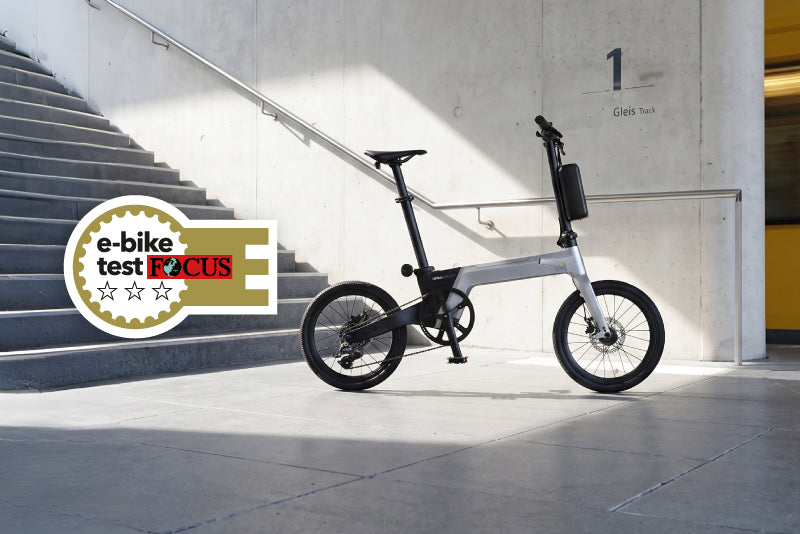
Lemmo has stayed true to its core concept with the Collab.Ride — but now the manufacturer wants more. Much more. In the marketing copy accompanying the launch, it reads something like this:
What if a bicycle could act more actively, anticipate, adapt, and move with you? Not just as a machine beneath you — but as a true extension of your body. A moving exoskeleton. What if the bike didn’t just follow commands, but collaborated with you? Not control, but partnership. A system that understands the rider’s intent on a deeper level — responding intuitively, adapting intelligently, and evolving into a new form of embodied intelligence.
Too much marketing talk? We think so too. In simpler terms, it boils down to this: Lemmo has added an electronic shifting system. Wow. Wow?
Electronic shifting systems are, of course, nothing new and have long been available from various manufacturers. In the pre-production model we tested, Lemmo uses an electronic derailleur from Chinese manufacturer Wheeltop (EDS), which also supplies the handlebar controls. Because the Lemmo One has an additional internal battery alongside the Smartpac, the electronic shifting continues to function even when the bike is used without the Smartpac in pure bicycle mode.
How well does the automatic shifting work?
The Lemmo e-bike features a 10-speed chain drivetrain. What makes it special is that the gears shift not only electronically but also automatically — something quite unusual for chain-driven systems.
To achieve this, the bike continuously measures cadence and torque. Based on this data, the onboard software selects the most appropriate gear for the riding situation. The selected gear is displayed on the frame-integrated screen, just below the current motor assistance level.
In real-world testing, we found that it works well during relaxed cruising on flat terrain, such as in Hamburg — but it does have its quirks.
For example, when coming to a stop from high speed in a high gear, the system doesn’t always have enough time to shift down properly. Fortunately, riders can override the automatic shifting at any time using the handlebar controls, selecting gears manually via two buttons.
The system also shows room for improvement on climbs. Sometimes, by the time it finds the right gear, you’ve already lost momentum. Here again, manual intervention is often the better option.
With the firmware tested, the bike automatically returns to auto mode after a short time. Future software updates are expected to allow continuous manual shifting, which should also help avoid “clunky” gear changes that can occur under heavy load.
Upcoming firmware updates are also set to introduce different riding modes that influence both shifting and motor assistance. Lemmo has already announced features such as a Fitness Mode and a Cardio Mode, where the bike adapts to your calorie goals. Security features are also expected to be improved.
What else stands out during riding
The Lemmo One Collab.Ride offers an impressive amount of technology for a pedelec that proudly doubles as a regular bicycle when needed.
In everyday use, the numerous electronic features and mechanical systems work well together. The updated motor delivers slightly more punch than its predecessor while remaining impressively quiet. A suspension seatpost is now also available as an optional upgrade.
Thanks to the torque sensor, the assistance feels very natural — although the difference between support levels is still not very pronounced.
Range remains unchanged: depending on the assistance level, you can expect up to around 70 km, similar to previous models.
We still really like the smartphone mount integrated into the handlebar. And the ability to track performance in the companion app is a welcome addition. This is made possible by the newly integrated power meter — a feature typically found only on more performance-oriented bikes like road bikes.